Compare
SD-WAN vs MPLS Cost and Migration
Key Takeaways
SD-WAN routes traffic over any transport (broadband, DIA, LTE/5G) and connects directly to cloud applications, typically cutting WAN costs 30 to 50 percent versus MPLS. MPLS is a private, carrier-managed circuit with hard SLAs, still the right tool for latency-critical traffic between fixed sites. Most mid-market, multi-site companies in 2026 land on pure SD-WAN or a hybrid. The decision comes down to your application mix, cloud adoption, and what your current contract actually costs.
MPLS was the enterprise WAN standard for two decades. SD-WAN is now the default for distributed businesses that run in the cloud. This 2026 decision guide covers real pricing, a worked 3-year TCO, and a practical migration path.

At a glance
SD-WAN
Software-defined WAN that routes traffic over any transport.
MPLS
Private, carrier-managed circuits with guaranteed SLAs.
Head-to-head comparison
| Criterion | SD-WAN | MPLS |
|---|---|---|
| Cost | Lower; uses commodity internet transport | Higher; dedicated private circuits |
| Performance | Best-effort with intelligent, application-aware routing | Guaranteed SLAs for latency, jitter, and packet loss |
| Cloud access | Connects directly to cloud applications | Traffic is backhauled through a central data center |
| Deployment speed | New sites live in days | Provisioning can take weeks to months |
| Security | Pairs with SASE for a full zero trust posture | Inherent isolation, but no encryption by default |
What is MPLS? What is SD-WAN? 2026 definitions
MPLS (Multiprotocol Label Switching) is a private wide-area network service you rent from a carrier. Your traffic rides the carrier's backbone with labels that keep it isolated from the public internet and prioritized end to end. The carrier commits to hard numbers in the contract: typically sub-5ms jitter and under 0.1 percent packet loss between your sites. That determinism is what you are paying for, and in 2026 it still costs roughly $50 to $100 per Mbps per month in the US mid-market. A 100 Mbps MPLS circuit commonly runs $1,500 to $3,000 per site per month.
SD-WAN (Software-Defined Wide Area Network) is an overlay, not a circuit. Edge appliances at each site build encrypted tunnels across whatever transport you give them: dedicated internet access (DIA), cable broadband, fiber, LTE or 5G. Software measures every path continuously and steers each application over the best one in real time. Voice can ride the low-jitter path while backups ride the cheap one. When a circuit degrades or fails, traffic moves in under a second.
Two forces define the 2026 version of this decision. First, SASE convergence: Gartner projects that 60 percent of new SD-WAN purchases this year are part of a single-vendor SASE offering, up from 15 percent in 2022, so the WAN decision and the security decision are now the same conversation. Second, the copper sunset: carriers are actively decommissioning copper-fed circuits and repricing the stragglers, in some documented cases up to 10x. If your MPLS runs on legacy copper, your renewal is not going to look like your last invoice.
MPLS replacement: what replaces it, what it costs, and how to migrate
MPLS replacement means moving your site-to-site traffic off private carrier circuits and onto an SD-WAN overlay that runs over two diverse internet paths at each site. The circuits you stop paying for cost $50 to $100 per Mbps per month, which puts a single 100 Mbps MPLS circuit at $1,500 to $3,000 per site. What replaces them is dedicated internet access at roughly $5 per Mbps, a broadband or 5G second path at $50 to $150, an SD-WAN license at $100 to $300 per site, and, if you want someone else to run it, co-managed or fully managed service at $125 to $375 per site. Most mid-market companies land on pure SD-WAN. The ones with latency-critical traffic between fixed sites keep a small MPLS footprint and run SD-WAN for everything else.
| Line item | MPLS | SD-WAN replacement |
|---|---|---|
| Transport, 100 Mbps per site | $1,500 to $3,000 per month for a private circuit | About $500 for DIA plus a $50 to $150 second path |
| Overlay license | Included in circuit pricing | $100 to $300 per site per month |
| Management | Carrier NOC, change fees extra | $125 to $375 per site per month if co-managed or fully managed |
| Edge hardware, one time | Carrier-provided CPE | $500 to $2,000 small office, up to $12,000 high-capacity |
| All-in per site per month | $1,500 to $3,000 | $900 to $1,300 |
| Typical reduction | Baseline | 30 to 50 percent; the worked 10-site example below lands near 35 percent |
Every figure here is a 2026 US mid-market range, the same ones used in the full cost section further down. Your quotes depend on the street address, the loop, and the contract; two buildings a mile apart can quote 40 percent differently.
MPLS to SD-WAN migration in five steps
- 1.Inventory every circuit, term end date, and early termination fee before you talk to a vendor. The contract sets the migration sequence.
- 2.Order the internet underlay first. DIA installs run 45 to 90 days in most US metros, so the circuits are the long pole.
- 3.Deploy SD-WAN as an overlay on the MPLS you already have. MPLS becomes one path among several, with zero risk to production traffic.
- 4.Cut over in waves of 3 to 5 sites. Steer low-risk traffic first, and hold voice to jitter under 10ms and loss under 0.5 percent for two weeks before moving the next tier.
- 5.Disconnect MPLS on contract boundaries, not project boundaries. Keep a circuit as a paid backup path until its term ends rather than pay the termination fee.
The full eight-step guide, the pitfalls, and the decision matrix are further down this page. We run this sequence for multi-site companies through our SD-WAN and MPLS replacement service, source the underlay through our managed network and business internet practice, and do it locally for Dallas-Fort Worth multi-site companies.
How we run an MPLS replacement, site by siteManaged networks and business internet: sourcing the underlayMPLS replacement and SD-WAN for Dallas-Fort Worth companies
Architecture: how the two networks actually move traffic
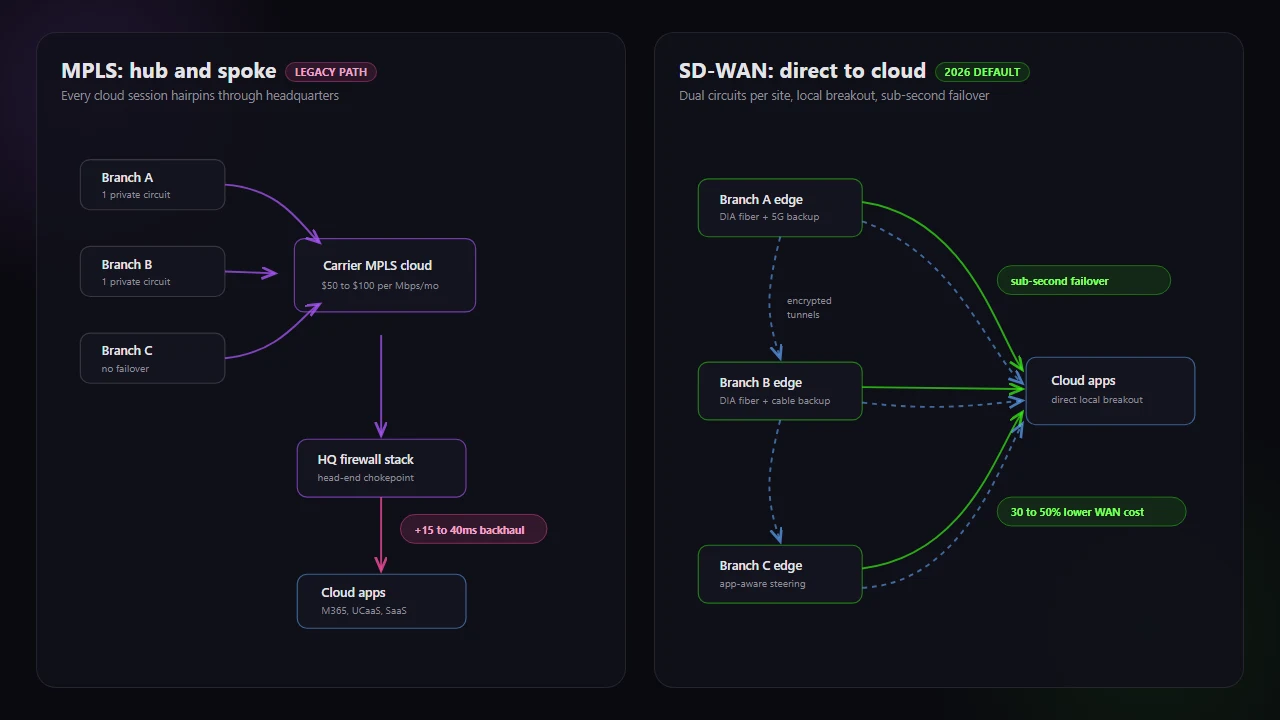
The clearest way to see the difference is to follow one packet from a branch office to Microsoft 365.
On MPLS, the branch has one private circuit to the carrier cloud. Internet-bound traffic usually cannot exit locally; it hauls back to your headquarters or data center, passes through the central firewall stack, and only then reaches Microsoft. That backhaul adds a measurable 15 to 40ms of latency to every cloud session, and it turns your head-end circuit into a chokepoint that you upgrade at MPLS prices.
On SD-WAN, the same branch has two diverse paths, for example a 200 Mbps DIA fiber circuit and a cable or 5G backup. The edge device recognizes the Microsoft 365 session and hands it directly to the closest Microsoft front door over the local internet. Site-to-site traffic rides encrypted tunnels across whichever path is currently performing best. There is no head-end chokepoint, and adding a tenth or fiftieth site does not mean re-engineering a hub.
Two design notes matter here. Diverse means genuinely diverse: two circuits from the same provider sharing one conduit fail together, so the second path should come from a different carrier over different physical infrastructure, with 5G as a clean third option. And during a migration, MPLS itself can serve as one of the paths; the overlay treats it like any other transport, which is what makes a phased, zero-downtime exit possible.
Performance comparison
| Metric | MPLS | SD-WAN (dual diverse circuits) |
|---|---|---|
| Latency (site to site) | Deterministic, contractually defined | Comparable on DIA; varies with underlay quality |
| Jitter | Sub-5ms, backed by SLA | Sub-8ms achievable in metros with dual circuits; best-effort on single broadband |
| Packet loss | Under 0.1 percent, backed by SLA | Path steering routes around loss; cannot fix a single bad circuit |
| Failover time | Seconds to minutes (routing reconvergence) | Sub-second, session-preserving |
| Cloud app performance | Penalized 15 to 40ms by central backhaul | Direct local breakout to cloud on-ramps |
| Reliability and SLAs | One carrier, one throat to choke, hard SLA | Resilience by design across two providers; SLA depends on underlay and provider mix |
The honest read: a single cheap broadband circuit under SD-WAN will underperform MPLS, full stop. The architecture only beats MPLS when the underlay is engineered, which means two diverse circuits from two providers at every site that matters. That is how the design brief should be written, and it is still dramatically cheaper than private circuits.
Cost comparison: CapEx, OpEx, and a real 3-year TCO
What MPLS really costs in 2026 (US mid-market ranges)
- Circuits: $50 to $100 per Mbps per month; a 100 Mbps circuit at $1,500 to $3,000 per site
- Change orders: adding bandwidth or a site is a 60 to 90 day carrier project, quoted at MPLS rates
- Hidden line items: copper-sunset repricing on legacy circuits (documented cases up to 10x), the 15 to 40ms cloud backhaul tax you pay in productivity rather than dollars, and head-end bandwidth upgrades forced by traffic that never needed to hairpin in the first place
What SD-WAN really costs in 2026
- Licenses and orchestration: $100 to $300 per site per month; $500 to $1,000 and up with integrated security bundles; $75 to $150 at volume
- Underlay: DIA at roughly $5 per Mbps (a 100 Mbps DIA circuit around $500 per month), plus a $50 to $150 broadband or 5G second path
- Edge hardware, one time: $500 to $2,000 small office, $1,500 to $5,000 branch, $5,000 to $12,000 high-capacity
- Co-managed or fully managed service: $125 to $375 per site per month depending on scope
Per site, per month at a glance
| WAN approach | Typical 2026 monthly cost per site |
|---|---|
| MPLS (single 100 Mbps private circuit) | $1,500 to $3,000 |
| SD-WAN full stack (dual circuits + license + co-management) | $900 to $1,300 |
| Typical savings | 30 to 50 percent; the worked example below lands near 35 percent |
Sample 3-year TCO: 10-site mid-market company (100 to 200 Mbps per site)
| Line item | MPLS scenario | SD-WAN scenario |
|---|---|---|
| Transport, all sites | $620,000 to $680,000 (10 x 100 Mbps private circuits) | $230,000 to $250,000 (dual internet: DIA + diverse backup) |
| Platform licenses | Included in circuit pricing | $85,000 to $95,000 (license + security) |
| Edge hardware (one time) | Carrier-provided CPE | $20,000 to $30,000 |
| Management | Carrier NOC, change fees extra | $50,000 to $60,000 co-managed |
| 3-year total | $640,000 to $700,000 | $400,000 to $440,000 |
That works out to roughly 35 percent savings, comfortably inside the 30 to 50 percent range businesses commonly see, while buying two circuits per site instead of one and multiplying usable bandwidth. Treat every number above as a range for a reason: exact pricing is street-address specific, distance and loop dependent, and heavily contract dependent. Two buildings a mile apart can quote 40 percent differently. This is exactly the modeling ObsidianX does against your actual invoices before you sign anything. If you want a quick checklist before that full review, run the free 5-sign telecom checklist against your current circuits.
Want these tables built from your real invoices instead of industry ranges? Start the free assessment below. No obligation, and the numbers are yours to keep.
Run your own numbers: SD-WAN savings calculator
Every rate below is the midpoint of a range published in the tables above. Adjust the inputs to your estate and see the 3-year math.
Estimated 3-year totals
Current MPLS path
$720,000
SD-WAN path (dual circuits per site)
$403,000
Licenses $72,000 + underlay $216,000 + management $90,000 + one-time hardware $25,000
Estimated savings
$317,000 (44%)
Typical realized savings land in the 30 to 50 percent range. These are industry-range estimates. Actual savings depend on your contracts, locations, and design. We will model your real invoices for free.
Model My Real Invoices, FreeMPLS replacement decision matrix: SD-WAN or hybrid
| Your situation | Best fit | Why |
|---|---|---|
| 5 to 15 sites, apps in the cloud (Microsoft 365, UCaaS, SaaS) | SD-WAN | Direct cloud breakout, dual-circuit resilience, fast site turn-up |
| 10 to 50 sites, mixed legacy and cloud applications | SD-WAN or hybrid | Overlay SD-WAN first; retire MPLS circuit by circuit as contracts allow |
| Real-time transaction processing or medical imaging strictly between fixed sites | MPLS or hybrid | Hard jitter and loss SLAs still matter for a small class of traffic |
| Operations that run big contact centers on cloud CCaaS | SD-WAN with dual DIA | Voice quality follows underlay quality; engineer it and monitor it |
| International footprint | Hybrid, region by region | In several overseas markets DIA and MPLS pricing converge, so run the math per region |
| Frequent M&A or seasonal sites | SD-WAN | New sites live in days on any available transport, not weeks to months |
| Risk posture: single-carrier accountability above all | MPLS or managed hybrid | One SLA, one throat to choke, and you pay the premium for it |
Download the full comparison matrix
The tables on this page, expanded into a 55-point SD-WAN vs MPLS comparison PDF you can put in front of your team: architecture, performance, cost, security, operations, reliability, and migration, side by side.
- 55+ comparison points across 7 categories
- The same published ranges and TCO math as this page
- Built for internal buy-in conversations and RFP prep
Security and SASE readiness
MPLS is private, but private is not secure. Traffic is unencrypted by default, there is no traffic inspection built in, and a private circuit does nothing about the majority of traffic that now terminates on the internet anyway.
SD-WAN encrypts every tunnel by default and, more importantly, is the on-ramp to SASE: cloud-delivered firewall, secure web gateway, and zero trust network access applied consistently to every site and remote user. This is where the market has moved. Gartner projects 60 percent of new SD-WAN purchases in 2026 are part of a single-vendor SASE offering, and 67 percent of enterprises plan to integrate SD-WAN with SASE capabilities by the end of the year.
One vendor-neutral caution: single-vendor SASE is operationally simpler, but it concentrates your network and your security in one contract. Sometimes that is right. Sometimes a best-of-breed pairing wins on capability or price. This is a supplier-selection problem, and it deserves a competitive process rather than a default.
How we run cybersecurity evaluations
MPLS to SD-WAN migration guide without downtime
What actually works, from RFPs and cutovers we have run:
- 1.Inventory circuits and contracts first. Pull every circuit ID, term end date, and early termination fee before you evaluate a single vendor. ETF overlap is the most common source of double-paying, and renewal auto-extensions are the second.
- 2.Order internet underlay early. DIA installs run 45 to 90 days in most US metros. This is the long pole; start it the week the project is approved.
- 3.Deploy SD-WAN as an overlay on the MPLS you already have. The edge devices treat MPLS as just another path. You get central visibility and app-aware routing on day one with zero risk to production traffic.
- 4.Dual-run and test per application. Steer low-risk traffic to internet paths first. Define pass criteria before cutover: for voice, hold jitter under 10ms and loss under 0.5 percent across a two-week window before moving the next tier.
- 5.Cut over in branch waves. Groups of 3 to 5 sites per wave, with a defined rollback: re-steer to MPLS in minutes if a wave misbehaves.
- 6.Disconnect MPLS on contract boundaries, not project boundaries. Time disconnects to term end dates. Where a term runs long, keep the circuit as a paid-for backup path until it expires.
- 7.Update the IP-dependent plumbing before each cutover. New circuits mean new public IPs: refresh firewall rules, SaaS and banking allowlists, site-to-site VPN peers, and lower DNS TTLs a week ahead so the swing is invisible to users.
- 8.Instrument day-2 operations. Per-path jitter, loss, and utilization dashboards per site. SD-WAN gives you the telemetry MPLS never did; use it.
Common pitfalls: a single cheap broadband circuit as the only underlay (the number one cause of "SD-WAN ruined our voice quality" stories), forgetting the fax lines, alarm panels, and elevator lines quietly riding old circuits, underestimating DIY management effort, and signing SD-WAN terms that outrun the MPLS ETFs they were supposed to replace.
Real-world example: 10 sites, 100+ cameras, $18,113.76 a year back
HomeBoy Industries, the Los Angeles non-profit and social enterprise, ran 10 locations serving over 10,000 individuals annually. Nine of the ten sites sat on single circuits with no failover. The Atlantic Avenue facility alone operated 100+ IP security cameras requiring 200 to 400 Mbps of sustained upload, on infrastructure never designed for it, and the legacy WAN included $1,100 per month of EPL and Metro-E circuits doing work commodity internet could do.
Working with our partner Circle MSP, ObsidianX designed and deployed a VeloCloud SD-WAN across all 10 locations: 1 Gbps dual-DIA at the site with heavy camera traffic, diverse circuits at every location, and application-aware failover so camera streams, VoIP, and case-management systems each get the path they need. Every circuit consolidated to a single invoice.
The result: $1,509.48 per month in total savings, $18,113.76 per year, with payback in roughly two months, and 100 percent camera uptime protection at the site where evidence-grade video cannot drop. "ObsidianX found savings we did not know existed and gave every site a network that just works," said Omar Rahmat of Office Technology Partners.
Read the full HomeBoy Industries case studyChoosing a platform? Cisco SD-WAN vs the 6 best alternatives
The verdict
Most multi-site businesses that run in the cloud are better served by SD-WAN. MPLS still makes sense for legacy, latency-critical applications running strictly between fixed locations. A hybrid approach, MPLS for the most sensitive traffic and SD-WAN for everything else, is common.
Frequently Asked Questions
Questions buyers actually ask about sd-wan vs mpls, answered plainly.
Can I run SD-WAN alongside my existing MPLS circuits?
Yes. SD-WAN can overlay existing MPLS circuits, giving you centralized visibility and intelligent routing while still leveraging your MPLS investment during a phased transition. In practice this is how most migrations start: the MPLS circuit becomes one path among several, and you retire it on your contract schedule rather than the project's.
How much can I save switching from MPLS to SD-WAN?
Businesses commonly see a 30 to 50 percent reduction in WAN costs, though exact savings depend on your current circuit count, locations, and bandwidth needs. The savings come from replacing $50 to $100 per Mbps private circuits with internet transport at a fraction of that, and they usually arrive alongside a bandwidth increase, not instead of one.
Is SD-WAN as secure as MPLS?
Modern SD-WAN platforms include next-generation firewall features, encryption, and segmentation, and pair with SASE for a security posture that goes beyond what a private MPLS circuit provides on its own. MPLS isolation is real, but it is not encryption and it is not inspection.
Is MPLS dead in 2026?
No, but it is a niche product now. It remains the right answer for a narrow class of latency-critical, site-to-site traffic and for organizations that value a single carrier SLA above cost. Carriers are repricing legacy copper-fed circuits aggressively, so even committed MPLS shops should re-quote at every renewal.
How long does an MPLS to SD-WAN migration take?
Plan on 45 to 90 days for internet circuit installs, then branch waves of 3 to 5 sites. A 10-site company typically completes the technical migration inside a quarter; the full financial migration ends when the last MPLS contract term does.
Can SD-WAN handle VoIP and video reliably?
Yes, with the right underlay. Dual diverse circuits per site keep jitter under 8ms in most US metros, and per-application steering moves calls off a degrading path in under a second. A single budget broadband circuit cannot make that promise, which is why we design two paths at every site that takes calls.
What does SD-WAN cost per site in 2026?
Licenses run $100 to $300 per site per month, $500 to $1,000 and up with security bundles, plus internet transport (DIA around $5 per Mbps) and one-time edge hardware from $500 to $5,000 for most sites. Managed service, if you want it, adds $125 to $375 per site. Volume changes all of these numbers, which is why quotes belong in a competitive process.
What is hybrid SD-WAN and MPLS, and who needs it?
Hybrid keeps a small MPLS footprint for the few applications that genuinely need contractual latency guarantees, while SD-WAN carries everything else and manages both. Multi-site companies with legacy real-time systems, and international footprints where local MPLS pricing is competitive, are the usual candidates.
What happens when an internet circuit fails under SD-WAN?
The edge device detects loss, latency, or brownout conditions and moves traffic to the surviving path in under a second, preserving active sessions. Users on a call typically never notice. With MPLS, failover depends on routing reconvergence and often a truck roll.
What should I check in my MPLS contract before switching?
Three things: early termination fees and their dates, auto-renewal clauses (many renew 60 to 90 days before term end), and whether any circuits are copper-fed and exposed to sunset repricing. Bring the contract to the first conversation; it changes the migration sequence more than any technical factor.
What is MPLS replacement?
MPLS replacement is retiring the private carrier circuits that connect your sites and carrying that traffic over an SD-WAN overlay on dual internet paths instead. The private circuits cost $50 to $100 per Mbps per month. The replacement is dedicated internet at roughly $5 per Mbps plus a second path, an SD-WAN license, and optional managed service, which lands most sites at $900 to $1,300 per month against $1,500 to $3,000 for a single 100 Mbps MPLS circuit. Sites with latency-critical traffic between fixed locations can keep a small MPLS footprint in a hybrid design.
Is SD-WAN cheaper than MPLS?
For most multi-site companies, yes. SD-WAN replaces $50 to $100 per Mbps private circuits with internet transport at a fraction of that, and the full stack of dual circuits, license, and co-management typically runs $900 to $1,300 per site per month against $1,500 to $3,000 for a single 100 Mbps MPLS circuit. Businesses commonly see 30 to 50 percent lower WAN costs, and the worked 10-site example on this page lands near 35 percent while buying two circuits per site instead of one. The exception is traffic that needs contractually guaranteed latency between fixed locations; that can stay on MPLS in a hybrid.
What replaces MPLS for connecting multiple offices?
An SD-WAN overlay running over two diverse internet circuits at each office: dedicated internet access as the primary path and broadband, fiber from a second provider, or 5G as the backup. The overlay encrypts site-to-site traffic, steers each application to the best path in real time, and connects directly to cloud applications instead of backhauling them through a data center. Where a private core still matters, carriers also sell managed private networking on their own fiber, and a hybrid keeps MPLS for that traffic only.

Free Tech Stack Assessment
Find out what your stack should cost
Tell us where it hurts and we will benchmark your current setup against the market. No sales pitch, just answers.
- A ranked list of savings and upgrade opportunities in your stack
- Benchmarked against 250+ vetted suppliers, not one vendor's catalog
- Yours to keep with no obligation, whoever you build with
Ready to Get a Straight Answer for Your Business?
We benchmark your current setup against the market and give you a specific recommendation, not a sales pitch. Free consultation, no obligation.
Vendor-agnostic advice. No quotas, no obligation, no pressure.
Prefer a quick checklist first?