January 2, 2025 · Brandon Stone, Managing Partner
SD-WAN vs MPLS: Which is Right for Your Business in 2025?
The way businesses connect their locations and access the cloud has fundamentally changed. For years, Multiprotocol Label Switching (MPLS) was the gold standard for enterprise wide-area networking. But the rise of cloud computing and the need for more agile, cost-effective connectivity has made Software-Defined Wide Area Networking (SD-WAN) an increasingly attractive alternative.
So, which is right for your business? In this guide, we'll compare SD-WAN and MPLS across key factors to help you make an informed decision.
MPLS is a private networking technology that routes traffic along predetermined paths using labels rather than IP addresses. It has been the backbone of enterprise WANs for over two decades, known for its reliability, security, and quality of service (QoS) capabilities.
Key characteristics of MPLS:
- Private, dedicated circuits
- Guaranteed bandwidth and low latency
- Built-in Quality of Service (QoS)
- High reliability and uptime
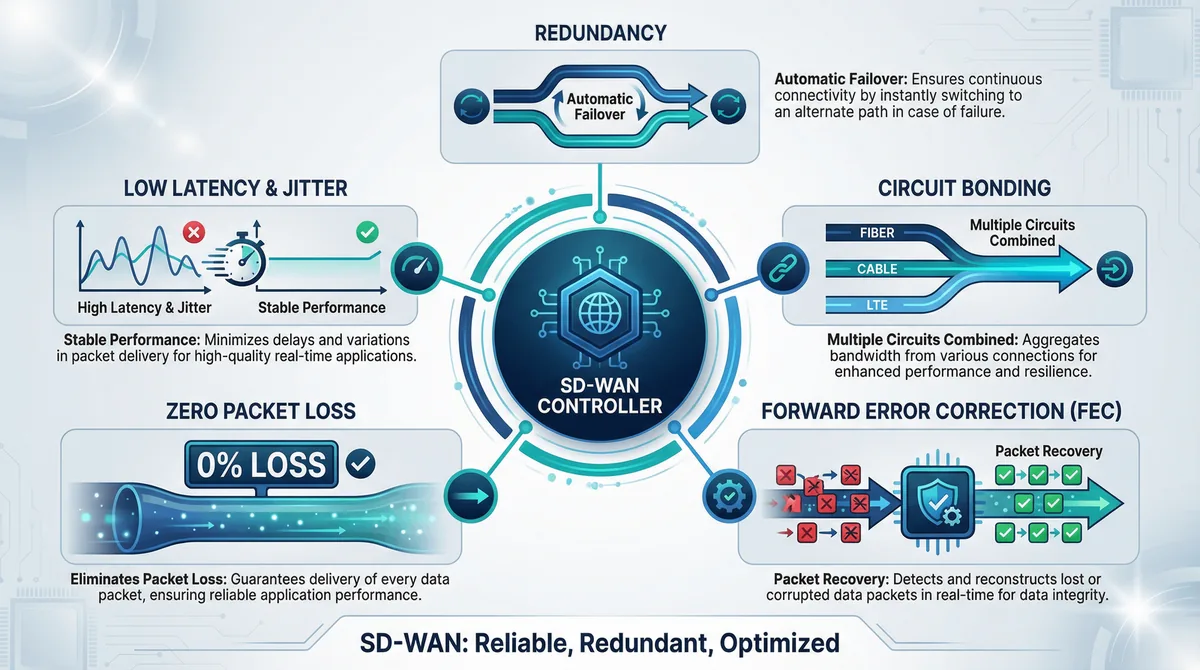
SD-WAN is a software-based approach to managing wide-area networks. It abstracts the network hardware and uses software to intelligently route traffic across multiple connection types, including DIA, broadband internet, and LTE/5G.
Key characteristics of SD-WAN:
- Uses any transport (MPLS, broadband, LTE)
- Centralized management and visibility
- Application-aware routing
- Built-in security features
- Lower cost than MPLS alone
MPLS operates like a dedicated, private lane on a highway, ensuring data packets travel a predetermined path. This reliability comes at a cost—literally and figuratively. MPLS circuits are expensive and take time to provision.
SD-WAN decouples the networking hardware from its control mechanism. It creates a virtual overlay that can bond multiple transport types to route traffic intelligently, prioritizing applications rather than just packets.
Known for high bandwidth costs. Since it relies on dedicated leased lines, scaling up bandwidth can be prohibitively expensive, especially for global enterprises.
Generally more cost-effective. By leveraging lower-cost broadband or dedicated internet access (DIA) alongside or instead of MPLS, businesses can achieve higher bandwidth at a fraction of the cost. ObsidianX clients often see a 30-50% reduction in WAN costs when migrating to SD-WAN.
Performance & Reliability
The gold standard for reliability. It offers strict Service Level Agreements (SLAs) for packet loss, latency, and jitter. If your business runs mission-critical, real-time applications (like legacy VoIP) between fixed locations, MPLS delivers consistent performance.
This is where SD-WAN truly shines. MPLS was designed for a branch-to-data-center traffic pattern. In a cloud-first world, backhauling cloud traffic through a central hub adds unnecessary latency. SD-WAN routes traffic directly to cloud applications, delivering better performance for the way businesses actually work today.
Considered secure because traffic is isolated from the public internet. However, it doesn't encrypt traffic by default, and once inside the private network, threats can move laterally.
Built with security in mind. Most modern SD-WAN solutions include next-generation firewall (NGFW) features, encryption, and segmentation capabilities. When combined with SASE (Secure Access Service Edge), SD-WAN offers a comprehensive security posture for the distributed enterprise.
SD-WAN vs MPLS: Head-to-Head Comparison
- Cost: MPLS is higher (dedicated circuits); SD-WAN is lower (uses commodity internet).
- Performance: MPLS offers guaranteed SLAs; SD-WAN is best-effort with intelligent routing.
- Cloud access: MPLS traffic is backhauled through the data center; SD-WAN connects directly to the cloud.
- Scalability: MPLS is limited and expensive to add sites; SD-WAN deploys new sites in days.
- Security: MPLS is inherent (private network); SD-WAN pairs encryption with additional security layers like SASE.
- Management: MPLS is carrier-managed; SD-WAN can be self-managed or co-managed.
SD-WAN is likely the better choice if you want to reduce WAN costs significantly, you are moving applications to the cloud, you need to deploy new sites quickly, you want more visibility and control over your network, or you have a distributed workforce.
The Verdict: Which Should You Choose?
- You have legacy applications that require absolute zero packet loss and low latency between specific data centers.
- Your remote branches strictly communicate with a central HQ and not the cloud.
- Cost is less of a concern than guaranteed SLAs.
Switch to (or add) SD-WAN if:
- Your organization uses cloud applications (SaaS, IaaS) extensively.
- You need to reduce WAN costs while increasing bandwidth.
- You need to deploy new branches quickly (days vs. months).
- You want centralized visibility and control over your entire network.
Many businesses are finding that a hybrid approach works best. You can use MPLS for your most critical, latency-sensitive applications while leveraging SD-WAN and broadband for everything else. This gives you the best of both worlds: the reliability of MPLS where you need it and the cost savings and agility of SD-WAN everywhere else.
SD-WAN: Reliable, Redundant, Optimized
As a vendor-agnostic technology consultant, ObsidianX can help you evaluate your current WAN infrastructure, design a solution that meets your specific needs, compare solutions from multiple SD-WAN and MPLS providers, and manage the implementation and ongoing optimization.
are designed to modernize your network without disrupting operations. We can also help you compare providers and negotiate contracts to ensure you get the best performance for your budget.
Q1: Is SD-WAN more secure than MPLS?
A: MPLS is inherently private, while SD-WAN traffic travels over the public internet. However, modern SD-WAN solutions include robust encryption and security features that can make them just as secure as MPLS.
Q2: Can I use SD-WAN with my existing MPLS circuits?
A: Yes! SD-WAN can overlay your existing MPLS circuits, allowing you to get the benefits of SD-WAN while still leveraging your MPLS investment.
Q3: How much can I save by switching from MPLS to SD-WAN?
A: Many businesses see cost savings of 30-50% or more when replacing MPLS with SD-WAN, depending on their specific situation.
Ready to optimize your WAN?
Contact ObsidianX for a free network assessment. Call 469.436.3232.
Request Free Network Assessment
Take SD-WAN SASE Assessment
Get a free network architecture review and discover if SD-WAN is the right move for your business in 2025.